
- In the 1930s, Kurt Lewin immigrated from Germany to the United States
and laid the foundations for research in human relations. Lewin was
one of the founding fathers not only of social psychology but
also of work and organisational psychology. He was one of the first
to conduct a systematic analysis of an issue fundamental to social and
personality psychology, namely the relative contributions of personality
and social environment to human behaviour.
- Additionally, Lewin strongly emphasised the complementarity of basic
and applied research.
- Famous for the saying:
- "There is Nothing So Practical as a Good Theory"
- "If you want truly to understand something, try to change it."
- The power of Lewin's theorizing lay not in a formal propositional
kind of theory but in his ability to build "models" of processes that
drew attention to the right kinds of variables that needed to be conceptualized
- Genidentity
- The concept of "genidentity", which Kurt Lewin introduced in his
1922 Habilitationsschrift, "Der Begriff der Genese in Physik, Biologie
und Entwicklungsgeschichte" ("The concept of genesis in physics,
biology, and the evolutionary history") is today perhaps the only
surviving evidence of Lewin's influence on the philosophy of science.and
observed.
- For Lewin, "genidentity" is an "existential relationship" underlying
the genesis of an object from one moment to the next. According
to this interpretation, what we usually consider an object really
consists of a multitude of entities, as it were, the phases of the
object at various times. Two objects are not genidentical because
they have the same properties and characteristics, but because one
has developed from the other.
- The principal characteristics of Lewin's field theory may be summarised
as follows:
1.behavior is a function of the field that exists at the time the
behavior occurs,
2.analysis begins with the situation as a whole from which are differentiated
the component parts, and
3.the concrete person in a concrete situation can represented
mathematically.
- Lewin also emphasizes underlying forces (needs) as determiners ofbehavior
and expresses a preference for psychological as opposed to physical
or physiological descriptions of the field. A field is defined as "the
totality of coexisting facts which are conceived of as mutually interdependent"
(Lewin, 1951, p. 240)
- As you might guess from the paragraph quoted above, Lewin uses the
language of physics, geometry and mathematics in analyzing human behavior.
- Bibliography
- Lewin, K. A dynamic theory of personality. New York: McGraw-Hill,
1935.
- Lewin, K. Principles of topological psychology. New York: McGraw-Hill,
1936
- Lewin, K. The conceptual representation and measurement of psychological
forces.
- Lewin, I. Resolving social conflicts; selected papers on group
dynamics. Gertrude W.
- Lewin (Ed.). New York: Harper & Row, 1948.
- Lewin, K. Field theory in social science; selected theoretical
papers. D. Cartwright (Ed.). New York: Harper & Row, 1951
- Group Dynamics is founded on Lewin's concept of action research. Lewin
felt that social problems, including conflict, leadership, and adjustment,
should be solved scientifically for there "is no hope of creating a
better world without a deeper scientific insight into the function of
leadership and culture" and other essentials of group life (Lewin, 1948,
p. 113). Lewin's action research argues against the traditional distinction
between basic and applied science by suggesting that scientific understanding
will occur most rapidly if researchers and practitioners's efforts are
unified. Extending Lewin's unificationist view, we seek to strengthen
the unity of group psychology in terms of educational training experiences,
professional identity, shared methodological standards, the evolution
of discipline-spanning conceptual models of groups, and shared metatheoretical
and epistemological assumptions about how our knowledge of groups should
be expanded (see Forsyth & Leary, 1991). This unified approach to
the study of groups defines the standards, topics, and bent of the journal.
Kurt Lewin is considered to be by many, the most charismatic
psychologist of his generation. He was born in Germany in 1890. His formal
training in psychology began in 1910 in Berlin and led to a Ph.D. in the
experimental study of associative learning.
During World War I Lewin served as a private and eventually
became a lieutenant in the German army. He was wounded in action and received
an Iron Cross. After the war he returned to the Psychological Institute
in Berlin where he became Privatedozent in 1921. In 1927, at the
age of 37, he advanced to Ausserordentlicher Professor.
Lewin came to the United States in 1932 as a visiting professor
to Stanford University. His influence in America was immediate. Lewin’s
published many books before his arrival to the United States and after.
With Fritz Heider, a fellow refugee friend from Berlin, and his American
wife Grace, he wrote Lewin’s Principles of Topical Psychology. Lewin
left Stanford for Cornell and eventually settled down at the University
of Iowa from 1935 to 1944. After Lewin moved from Iowa he established and
directed the Research Center for Group Dynamics at the Massachusetts Institute
of Technology.
Lewin is most renown for his development of the field theory.
The field theory is the "proposition that human behavior is the function
of both the person and the environment: expressed in symbolic terms, B =
f (P, E)."(Deaux 9) This means that one’s behavior is related both to one’s
personal characteristics and to the social situation in which one finds
oneself.
The field theory may seem obvious to us now, but most early
psychologist did not believe in behaviorism. Many psychologists at the time
believed in the psychoanalytic theory that held human motives to be blind
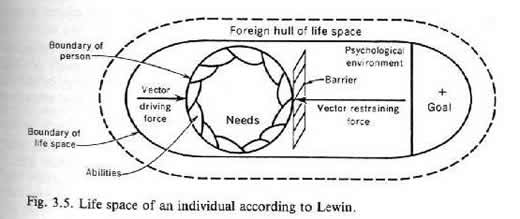
pushes from within. Lewin thought of motives as goal- directed forces. He
believed "that our behavior is purposeful; we live in a psychological reality
or life space that includes not only those parts of our physical and social
environment that are important to us but also imagined states that do not
currently exist" (Tesser 340).
Lewin’s field theory lead to the development of actual field
research on human behavior. With boldness, Lewin manipulated complex situational
variables in natural settings. His approach has guided experiments in the
field of social cognition, social motivation, and group processes. Most
importantly Lewin helped develop action research. Action research uses empirical
social research, social action, and controlled evaluation.
Clearly, Kurt Lewin’s field theory and action field research
has one of the most outstanding impacts on modern social psychology. His
field theory explained that our actions are a result of both environmental
and psychological traits. We are not just beings who act from internal impulses.
Instead we are greatly influenced by our surroundings.
Lastly Lewin’s belief that social-psychological phenomena
can be studied experimentally was a huge impetus for scientific research.
He was the first to test human behavior in a controlled setting. His research
also showed events must be studied in
relation to one another, and that both the individual and
the group are important. His research helped to better explain leadership
atmospheres and group dynamics.
Kurt Lewin’s influence on scientific research is his legacy.
He was a ground-breaking psychologist who greatly impacted his field. Kurt
Lewin will continue to influence both theory and research all the way to
and beyond the twenty-first century.


