Although Jim Rough and Associates, Inc. has been teaching public
seminars in Dynamic Facilitation Skills since 1990, it is still
new. It's a social invention that is just now beginning to take
off! It's a way that time-constrained managers, ordinary citizens
in public meetings, conflicted employees in team meetings, or students
in a high school can speak their minds and hearts in a meeting,
without being specially trained, and have it work out great. The
facilitator structures the dynamic flow of conversation so each
comment becomes an asset to the group and builds to a breakthrough.
With Dynamic Facilitation skills you empower people to solve impossible-to-solve
issues because you bring out a quality of thinking where people
operate at their best.
The dynamic facilitator establishes a “zone” of thinking and talking
known as “choice-creating,” where shifts and breakthroughs are normal.
It is like when people face a collective challenge and pull together
to creatively overcome it. Sometimes these shifts take the form
of new ideas, other times they bring a new sense of what the “real
problem” is, and other times there is a change of heart.
Some Benefits of Dynamic Facilitation
• Meetings arrive at better solutions to problems, faster, with
more consensus.
• Groups achieve breakthroughs on impossible-to-solve issues.
• People determine and resolve what's really on their minds.
• The process builds trust, respect, and the spirit of community.
• Everyone is engaged, enthused and committed to the results.
• People grow in personal creativity and capability.
How is it different?
Rather than seeking to manage change, the facilitator elicits,
sustains, and enhances the self-organizing dynamic of
change. He or she helps people to figure out what they
want and to get it themselves. The Dynamic Facilitator works more
completely with self-organizing change than the traditional facilitator.
The traditional facilitator elicits self-organizing change in the
realm of what people think, talk and decide about, but uses
the methods of control to manage how they think, talk and decide.
For instance, they are oriented to breaking big problems into smaller
ones, following an agenda or logical steps, and tracking progress
toward predetermined goals. It is an approach that minimizes what
might go wrong.
The Dynamic Facilitator assures a self-organizing dynamic both in
what people talk about and how they talk. He or she
follows group energy as being more important than any preset agenda,
expecting progress to happen in "shifts" of insight, feeling and awareness.
It leads to a creative thinking process known as "choice-creating" instead
of "decision-making." This approach maximizes what might go right
instead of minimizing what might go wrong. (See a chart of Dynamic
Facilitation compared to Traditional Facilitation.)
How Dynamic Facilitation Works
The dynamic facilitator focuses on group energy more than the agenda,
helping people to determine an isse they care about deeply. Then he
or she helps people to speak their minds and hearts. Normally, this
causes problems because others can take offense, but the dynamic facilitator
assures that each comment is appreciated, using four lists: 1) Solutions,
2) Concerns, 3) Data, and 4) Problem-statements. The high-quality
of dialogue that results yields spontaneous conclusions, which are
placed on a fifth list: 5) DECISIONS.
When to apply Dynamic Facilitation?
Most meetings aim to help people be logical and reasonable. But this
emphasis limits the potential of people to solve problems and form
community. Better is to take on bigger issues, while helping people
to think creatively together. Dynamic Facilitation is appropriate
for:
 • Big-issue meetings — dealing
with difficult times, crises or "impossible" problems; strategic
planning; sparking a leap forward, visioning. • Big-issue meetings — dealing
with difficult times, crises or "impossible" problems; strategic
planning; sparking a leap forward, visioning.
• Heart issues —resolving conflict, building
shared values, building community and teams.
• Dialogues —coachings, trainings, and personal
development.
• Straightforward meetings —quality improvement
meetings, staff meetings, simple decisions, presentations, planning,
etc.
In your next meeting notice
- Do people say what they really think, or do they hold back?
- Is the group addressing the real issue efficiently, or caught
in a minor topic? or over-analyzing?
- Are people being creative and seeking win/win solutions, or
trying to persuade others?
- Do people leave the meeting with enthusiasm and commitment?
Dynamic Facilitation uses the appropriate Level
of Thinking
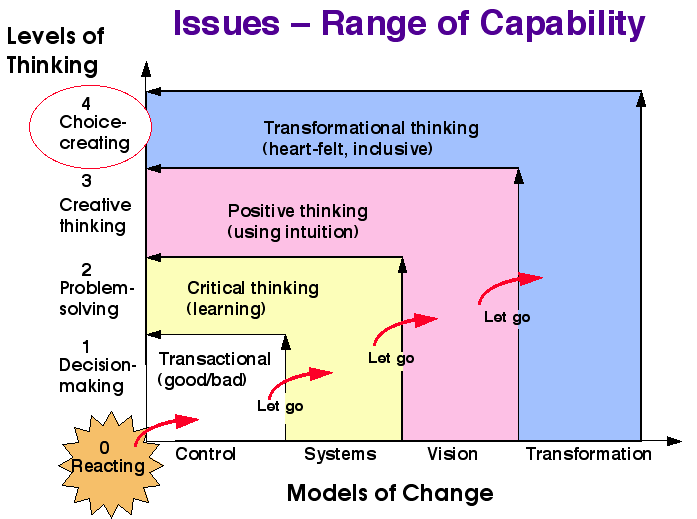
Four levels of thinking capability are shown in the chart below.
Each is associated with a particular model for how change happens.
Often, facilitators focus on one style of thinking and one model of
change, unknowingly limiting the capabilities of the group. The Dynamic
Facilitator starts from the highest level, helping people to address
the most pressing issue, but can downshift to the appropriate level
if smaller issues are chosen.
| Levels of Thinking |
Models of Change |
|
| Level 0: |
Reacting ... Here, the circumstances determine the situation.
There is no model of change, just avoiding pain and pursuing pleasure. |
|
| Level 1: |
Decision-making ... Here the idea is to establish options,
and then to choose the best according to preset standards. |
|
| Level 2: |
Problem-solving ... In this case one seeks to understand
the underlying causes to problems and to determine high leverage
solutions. This is systems thinking. |
|
| Level 3: |
Creative thinking ... Here one uses the unconscious,
creative mind to envision a desired future and to bring this future
into being. Brainstorming and appreciative inquiry are examples. |
|
| Level 4: |
Choice-Creating
... This is where important, big issues are addressed creatively,
with open minds and hearts. Win/win breakthroughs are the natural
result as well as increased trust and the spirit of community. |
|
|
The Dynamic Facilitator will often list possible
solutions, concerns, data, and problem-statements as a way to
value all people and all comments.
|
Articles:
|


