| |
Model Diagram
|
|
| |
 |
(vedi anche 1
- 2 - 3
- 4)
For Individuals, Families, Schools/Sites, and Communities
Many parts and pieces come together in the comprehensive Positive
Action program to bring positive changes to individuals,
families, schools/sites, and communities. The many parts and
their cohesive alignment are described in this program model
diagram. You can see exactly how everything fits together and
use the model as a guide in your own Positive Action
program. Here’s how it works in a nutshell.
The Positive Action model consists of three main parts:
how to prepare to implement the model, what the model is, and
how to know that the model works.
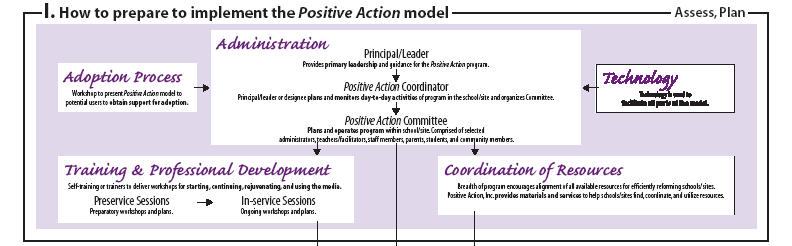
How to prepare to implement the Positive Action model
In the first part, the model outlines the adoption process,
necessary training, and professional development. The Positive
Action Coordinator (principal/leader or designee) and the
Positive Action Committee organize program administration
along with utilizing and coordinating resources.
What the Positive Action model is
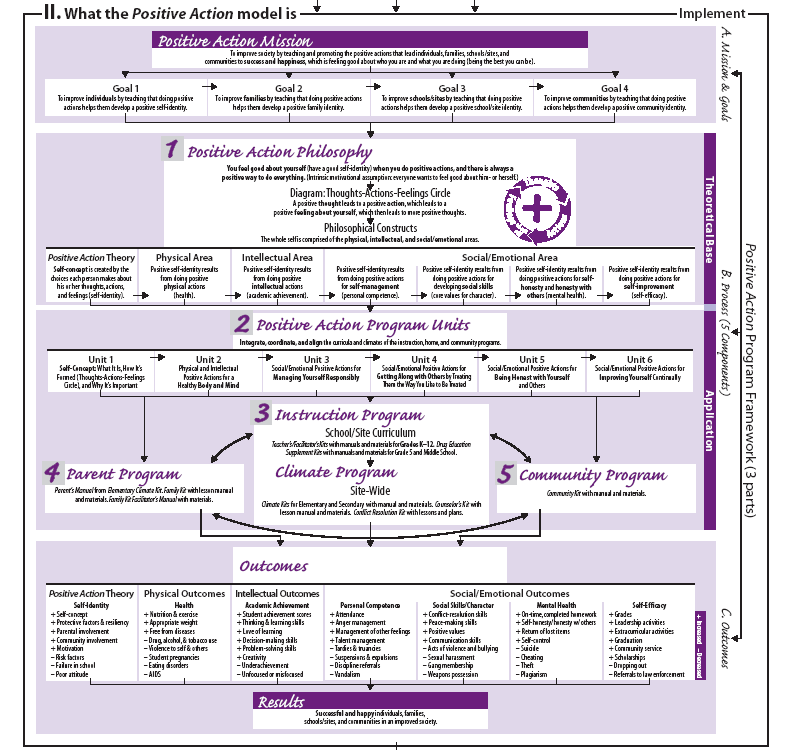
In the second part, a mission statement gives
the program’s purpose: “To improve society by teaching and promoting
the positive actions that lead individuals, families, schools/sites,
and communities to success and happiness, which is feeling good
about who you are and what you are doing (being the best you
can be).” There are four goals under the mission
statement: to improve (1) individuals, (2) families, (3) schools/sites,
and (4) communities by teaching that doing positive actions
helps to develop a positive identity.
The program philosophy, “You feel good about
yourself when you do positive actions, and there is always a
positive way to do everything,” underlies these goals. The philosophy
is illustrated in the Thoughts-Actions-Feelings Circle diagram.
The Positive Action program model applies the philosophy
in the six program units. Unit 1 explains what
self-concept is, how it’s formed (Thoughts-Actions-Feelings
Circle), and why it's important. Unit 2 teaches the physical
and intellectual positive actions for a healthy body and mind.
Units 4–6 teach positive actions for the social/emotional areas.
These unit concepts align and integrate the curricula and climates
of the instruction, home, and community programs.
The instruction program for schools/sites
includes the Positive Action curriculum and the site-wide
climate program. The K–12 curriculum features a separate Teacher’s/Facilitator’s
Kit for each grade that contains a manual with scripted
lessons and activities and other materials. Drug Education
Supplement Kits with manuals and materials for Grade 5
and Middle School are incorporated into the curriculum to prevent
drug, alcohol, and tobacco use.
The site-wide climate program centers on the
Elementary and Secondary Climate Kits with
a guide and materials to help students and staff practice and
reinforce positive actions site-wide. A Counselor’s Kit
has a manual with lessons and materials for classroom teaching,
individual and small group counseling, and parenting classes.
A Conflict Resolution Kit with seven lessons and Conflict
Resolution Plans teaches and promotes peaceful solutions
to conflict within schools/sites, families, and communities.
The parent program uses the Parent's Manual
from the Climate Kit and the Positive Action Family
Kit with manual and materials for a home curriculum that
parallels the instruction program in philosophy, program units,
curriculum, and climate development. The Family Kit Facilitator’s
Manual is available for facilitators of parenting classes
to teach seven sessions that train parents and families to use
the Family Kit.
The community program uses the Community
Kit to develop community activities that parallel the instruction
and home programs in philosophy, program units, curriculum,
and climate development.
The consistent outcomes are evidence of the
Positive Action program’s multiple effects on individuals,
families, schools/sites, and communities. This evidence is organized
according to the unit concepts in terms of increased positive
actions and decreased negative actions. The overall result of
increased positive actions and decreased negative actions is
successful and happy individuals, families, schools/sites, and
communities in an improved society.
How to know that the Positive Action model works
The third part of the model includes plans for monitoring implementation
of the model and evaluating results and outcomes. Implementation
plans measure how much was delivered, how well it was liked,
and how much was learned. Effectiveness is measured by internal
or external evaluations that measure increases in positive actions
and decreases in negative actions.

|


